

THE JOURNAL
Live bright, every day
Practical, reviewed wellness reading. Every article links to the ingredient and category it covers.
Ingredient guide
Slept a full night but still not refreshed?
Sleep quality matters just as much as how many hours you sleep. Looking after both a relaxed mind and a relaxed body may be one way to support better sleep.

Signs & signals
Always tired, low on energy, foggy-headed... could you be missing a nutrient?
Tiredness can sometimes be linked to not getting enough iron. Iron plays a role in making red blood cells, alongside vitamin C, vitamin B6, vitamin B12, folate and amino acids.
Ingredient guide
Good immunity isn't just about being strong. It's about balance
A healthy immune system doesn't always mean one that works as hard as possible. Caring for immunity is less about stimulating it and more about helping the body work in balance, through everyday habits and nutrients with different roles.

How it works
A tired brain isn't only about thinking too much. It may need the right nutrients, too
Beyond hard work and rest, nutrients such as B vitamins, choline and zinc are involved in the basic biochemical processes that help the body and brain work normally.
Ingredient guide
What is iron, and what does it do in the body?
Iron is a mineral the body cannot make for itself, and it contributes to the normal formation of red blood cells and haemoglobin, normal oxygen transport, normal energy-yielding metabolism, and the normal function of the immune system.
How it works
Which foods are high in iron, and what helps absorption?
Plenty of everyday Thai food is already high in iron; what changes the outcome is what you eat alongside it, because vitamin C increases iron absorption.
How it works
Why does the iron figure differ for men and women?
Iron requirements differ by sex and life stage: the recommended intake for women aged 19 to 50 is more than double that for men of the same age, and the figure for the next age band is lower.
Everyday care
When should you take iron, and away from what?
Iron is absorbed better on an empty stomach, though some people find that uncomfortable; it is usually spaced apart from calcium, tea and coffee, and vitamin C increases its absorption.
Ingredient guide
How do you read the iron amount on a label?
Labels usually give the weight of the compound first, with the amount of elemental iron in brackets; the bracketed figure is the one to compare between products.
Ingredient guide
What is folate, and what does it do in the body?
Folate is vitamin B9, and it contributes to normal red blood formation, normal amino acid synthesis and the normal function of the immune system.
Ingredient guide
Which nutrients does bone need?
Thai Notification No. 447 recognises calcium, vitamin D, magnesium and protein as each having a role in maintaining normal bone, and each does a different job.
Ingredient guide
What is magnesium, and what does it do?
Magnesium is a mineral that is a component of bones and teeth, and contributes to normal muscle and nervous system function, electrolyte balance, normal energy-yielding metabolism and normal protein synthesis.
Ingredient guide
What is omega-3, and how do DHA and EPA differ?
Omega-3 is a family of essential fatty acids, and Thai Notification No. 447 recognises that DHA and EPA contribute to the normal function of the heart.
Everyday care
Where does sodium hide in Thai food?
Thai Notification No. 447 recognises that reducing sodium intake contributes to the maintenance of normal blood pressure, and in Thai cooking most sodium comes from seasonings rather than from salt added at the table.
Everyday care
Which fats should you cook with day to day?
Thai Notification No. 447 recognises both reducing saturated fat and replacing it with unsaturated fat as contributing to the maintenance of normal blood cholesterol levels.
Ingredient guide
What do the B vitamins each do?
The B vitamins do different jobs, mostly around normal energy-yielding metabolism and normal nervous system function, and vitamin B1 is also linked to the normal function of the heart.
Ingredient guide
What is calcium, and how much do you need?
Calcium is the most abundant mineral in the body, needed for the maintenance of normal bones and teeth, and also involved in muscle function, neurotransmission and normal blood clotting.
Ingredient guide
How do you choose a collagen product?
Collagen products differ in source, peptide form, amount per serving and what else is formulated with them, and those four are what a label actually lets you compare.
How it works
What should you look at when choosing a fish oil?
Fish oils are compared on the actual EPA and DHA they provide, not on the total weight of fish oil, together with the form of the oil, capsules per serving and the price per unit of omega-3.
How it works
How do you choose a vitamin C, and is 1,000 mg necessary?
Vitamin C products differ in amount per serving, chemical form, format and what else is included, and a higher number does not automatically suit everyone.
How it works
What should you look at when choosing a probiotic?
Probiotics are compared on how fully the strain is identified, the CFU count and when that count is guaranteed, the storage requirement and what else is formulated in.
How it works
How do you choose a multivitamin that fits you?
Multivitamins are compared on what is in the nutrient table and at what level against reference intakes, how many tablets make a serving, and whether the formulation fills the gaps your own diet leaves.
How it works
What should you look at when choosing a calcium supplement?
Calcium products are compared on the elemental calcium per serving, the chemical form, whether vitamin D is included, and how many tablets a day's amount takes.
Ingredient guide
What is the difference between probiotics and prebiotics?
Probiotics are live microorganisms; prebiotics are food components that the microorganisms in the gut can use. The two terms mean different things.
How it works
How much fibre does a Thai diet give you?
Fibre comes in soluble and insoluble forms, and in Thai cooking the amount can usually be increased without changing what you eat.
Everyday care
Do fermented foods contain probiotics?
Fermented food and probiotics are not the same term. Some fermented foods contain live microorganisms; others do not, because they have been heat-treated.
Ingredient guide
Is retinol the same thing as dietary vitamin A?
Retinol applied to skin and vitamin A obtained from food are the same molecule, but the route is different. Dietary vitamin A carries recognised statements of its own.
Ingredient guide
What are collagen peptides?
Collagen is a structural protein the body makes for itself; collagen peptides are collagen broken into shorter chains during manufacturing.
Ingredient guide
How is vitamin C related to skin?
Thai Notification No. 447 recognises that vitamin C contributes to normal collagen formation for the normal function of skin.
Everyday care
How do you look after skin day to day in a hot climate?
Skin care in a hot climate is mostly a matter of daily routine: sun protection, fluids, sleep and a varied diet.
Ingredient guide
How do zinc and biotin relate to hair, nails and skin?
Thai Notification No. 447 recognises that zinc contributes to the maintenance of normal hair, nails and skin, and that biotin contributes to the maintenance of normal hair and skin.
How it works
Which nutrients are linked to growth?
Thai Notification No. 447 recognises that zinc contributes to growth, that protein contributes to growth and tissue repair, and that vitamin A has a role in body growth.
Ingredient guide
How do B12 and B6 relate to the nervous system?
Thai Notification No. 447 recognises that vitamin B12 contributes to the normal function of the brain and nervous system, and that vitamin B6 contributes to the normal function of the nervous system.
How it works
What should change about nutrition after fifty?
After fifty some requirements go up, such as calcium and vitamin D, while women's iron requirement goes down.
Everyday care
How much protein, and how do you keep muscle?
Thai Notification No. 447 recognises that protein contributes to growth and maintenance of muscle mass, and spreading protein across the day is easier than loading it into one meal.
Everyday care
How should you use your eyes on a long screen day?
Working at a screen is about distance, lighting and the rhythm of breaks, and most of it can be adjusted immediately without buying anything.
How it works
Which nutrients relate to normal vision?
Thai Notification No. 447 recognises that vitamin A, zinc and riboflavin contribute to the maintenance of normal vision.
How it works
Which nutrients relate to the immune system?
Thai Notification No. 447 recognises wording about the normal function of the immune system for eight nutrients.
How it works
How does the body get vitamin D in a sunny country?
Vitamin D is made when skin is exposed to sunlight, but indoor life, sunscreen and clothing mean how much is actually made varies a great deal.
Everyday care
What should active people watch with protein and iron?
People training regularly need more protein than the baseline figure, and iron is the point that comes up most in endurance sport.
Everyday care
How do you read PM2.5 and AQI figures?
PM2.5 and AQI are different numbers, and a 24-hour average is not the same as a 1-hour average. Read them correctly before planning the day.
Ingredient guide
What is quercetin, and which foods contain it?
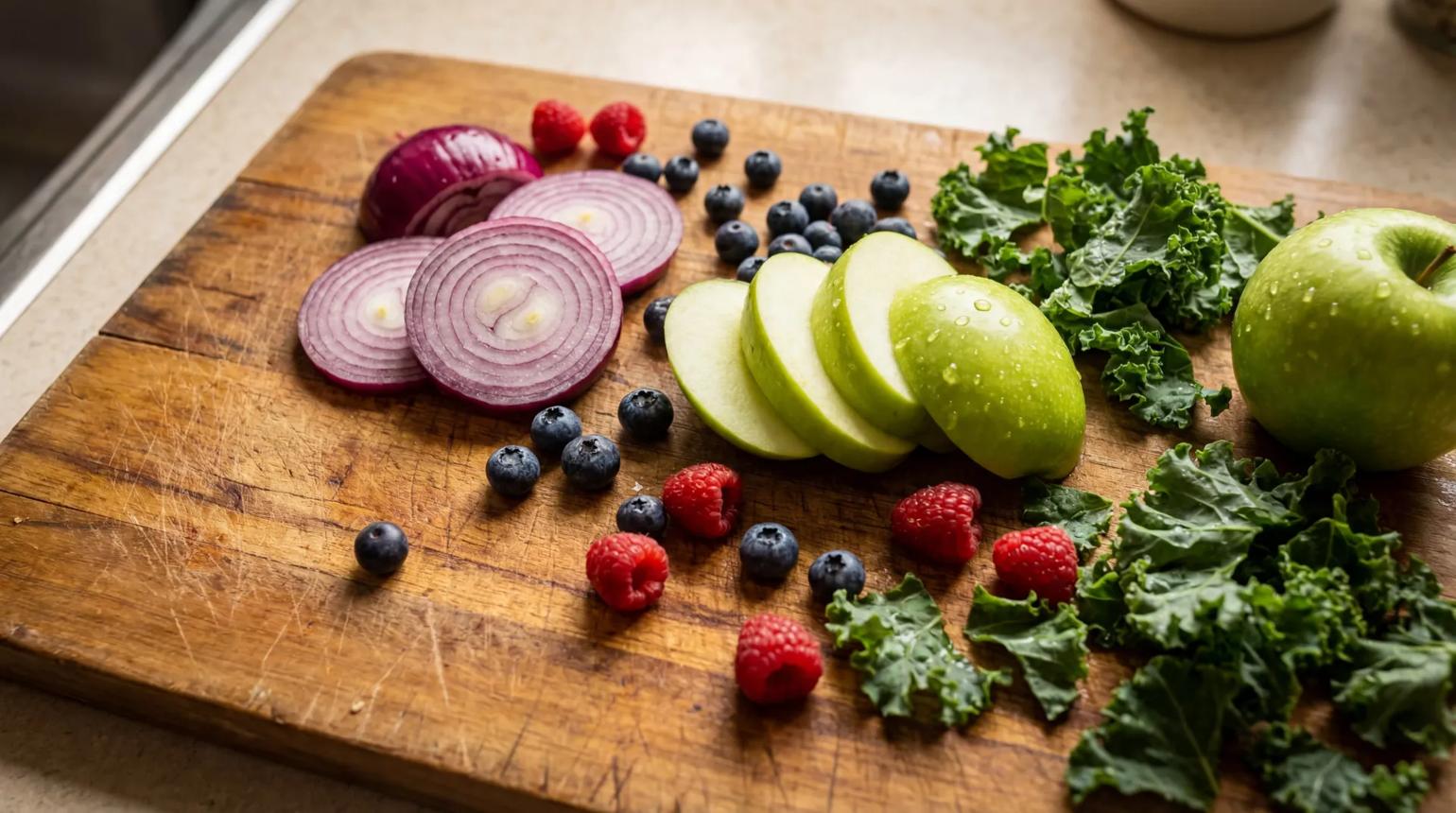
Quercetin is a flavonoid that occurs naturally in many plants, particularly shallots, onions, apples and tea.
Ingredient guide
What are essential amino acids?
Protein is built from amino acids. The body can make some of them and cannot make others; the second group are called essential and have to come from food.
Everyday care
How do you build a study schedule that holds up?
During exam preparation, what can actually be controlled is sleep timing, the rhythm of breaks, and the desk environment.
How it works
How do recommended intakes change with age?
Daily reference intakes are not fixed across a lifetime. Some rise with age and some fall, and the second part is the one usually missed.
Ingredient guide
Which part of the bean is soy germ?
Soy germ is the part of the soybean that would grow into the seedling. It is a small fraction of the bean and differs in composition from the rest of it.
Ingredient guide
What plant is dong quai?
Dong quai is the root of a plant in the genus Angelica. The root is the part used as a material, not the leaf or the seed.
Ingredient guide
What is evening primrose oil?
Evening primrose is a flowering plant. The material used is the oil pressed from its seeds, which contains gamma-linolenic acid.
Ingredient guide
What is Zinc?
Zinc is an essential trace mineral the body cannot store in quantity, so a small amount is needed from food every day. Recommended intakes are 11 mg a day for adult men and 8 mg for adult women.
Ingredient guide
Collagen for Dry Skin: How It Supports Hydration
Dry skin is a barrier issue before it is a collagen issue. Oral collagen peptides are studied as a dietary source of specific amino acids and peptides, in trials measuring hydration and elasticity over 8 to 12 weeks.
Ingredient guide
What is Quercetin?
Quercetin is one of the most abundant flavonoids in a normal diet, found mainly in onions, apples and tea. Human evidence is limited and mixed: the largest trial found no overall difference from placebo.
How it works
AGEs: The Glycation Behind Premature Skin Aging
Advanced glycation end products (AGEs) form when sugars attach to proteins without an enzyme, and they accumulate in dermal collagen and elastin because those proteins turn over slowly.
Ingredient guide
Longevity Set: Reset at the Cellular Level
The Longevity Set groups three VISTRA Sesamin Series products into a day, midday and night routine. Each study cited examined one specific combination, and one of them was conducted in cultured cells.
How it works
Tired-Looking Skin: An Early Sign of Cellular Aging
Dull or slack skin describes processes at cell level: cumulative oxidative damage to skin proteins, slower cell turnover and less available cellular energy. UV exposure is the largest external accelerator.
How it works
Fit Heart, Balanced Cholesterol
A lipid panel reports several numbers - LDL, HDL and triglycerides - because what matters is the balance between the particles. The DHA, EPA and sesame lignan finding is cell-culture work, not a human study.
Everyday care
Deep Sleep, Fresh Wake: A Good Day Starts with Sleep
Sleep quality and sleep quantity are not the same thing. Sleep runs in roughly 90-minute cycles, and the habits with the strongest evidence are a consistent wake time, morning daylight and a cool dark room.
Everyday care
Enjoy Every Step of Your Life
Comfortable everyday movement depends on the whole joint working together: cartilage, synovial fluid, ligaments and the surrounding muscles. UC-II is studied in 12 to 24 week trials at 40 mg a day.
How it works
Autophagy: The Science of Anti-Aging
Autophagy is the cell's own recycling system, recognized with the 2016 Nobel Prize in Physiology or Medicine. The sesamin and astaxanthin finding on ATP production comes from cultured cells, not from people.
Ingredient guide
Comparing Omega-3 Formulas: Which One Is Right for You?
Two bottles both labelled fish oil can differ in four measurable ways: chemical form, EPA and DHA per serving, source and purification, and any added nutrients. Those four are what you are actually comparing.
Everyday care
A Simple Routine for Radiant Skin Every Day
In published skin-nutrient trials the variable that matters is time, not the number of steps: protocols ran eight weeks for astaxanthin at 6 mg a day and twelve weeks for coenzyme Q10 at 50 mg a day.
How it works
The Link Between Oxidative Stress and Premature Skin Aging
Skin that looks older than your age mostly reflects cumulative exposure rather than the calendar. Dermatology research groups these external factors under the term skin aging exposome.
Ingredient guide
Enhancing Skin Resilience from Within
Astaxanthin, coenzyme Q10 and vitamin E are three fat-soluble antioxidants that each occupy a different part of the body's antioxidant network, which is why they are formulated together.
Ingredient guide
The Superior Duo Power of Vitamin C
Immune cells actively transport vitamin C inward and hold it at 10 to 100 times plasma levels. Mineral ascorbates deliver the same vitamin C molecule as ascorbic acid at a near-neutral pH.
Signs & signals
Fast-Changing Weather, Steady Immunity
Weather swings do not cause illness in themselves; they change behaviour and environment. Vitamin C is water-soluble with no meaningful reserve, so modest amounts across the day are more useful than occasional large ones.
Ingredient guide
rTG Omega-3: Triple Strength, Higher Bioavailability
Omega-3 comes in four chemical forms - natural triglyceride, ethyl ester, re-esterified triglyceride and phospholipid - and the form determines both achievable concentration and how the fatty acids are digested.
Ingredient guide
Tiny Fish Oil Capsules for All Generations
Capsule size reflects how concentrated the oil is, not its quality: at 60 to 85 percent EPA plus DHA, a much smaller capsule carries the same omega-3 as a standard 30 percent oil.
Everyday care
Beyond Sunscreen: Advanced Sun Protection From Within
Astaxanthin is a lipid-soluble carotenoid, examined in one Japanese randomized trial that measured skin response to a UV dose after nine weeks at 4 mg a day. An oral supplement carries no SPF and does not replace sunscreen.
Signs & signals
Bye Bye Migraine, Hello Magnesium
Magnesium is a cofactor in more than 300 enzyme reactions, with roles in normal nerve signal transmission and muscle function. Vitamins B1, B6 and B12 each have their own defined roles in the nervous system.
Signs & signals
Keep Knee Osteoarthritis at Bay for Good
Cartilage has no blood supply of its own and repairs slowly, so joint care is mostly load management, movement and strength. UC-II is studied at 40 mg a day over 90 to 180 days.
Ingredient guide
Tiny Microorganisms, Big Function for Gut and Skin
Postbiotics are compounds produced by microbial fermentation and contain no live cells, so they do not depend on surviving stomach acid. EpiCor is a dried Saccharomyces cerevisiae fermentate in this category.
How it works
Is Short Telomeres = Premature Aging True?
Telomere length is a research marker of cellular aging, not a health verdict. Evidence that diet or supplements meaningfully change it in humans is still early and has not been independently replicated.
Ingredient guide
Tiny Superfruit, Big Power for Immunity and Skin
Acerola cherry carries roughly 30 to 40 times as much vitamin C per unit weight as orange, which is why it is used as a vitamin C raw material in supplements.
Signs & signals
When Weather Changes, Let Vitamin C Help You
Vitamin C contributes to the normal function of the immune system and has to be renewed daily. On quercetin, the largest trial to date - 1,002 adults over 12 weeks - found no overall difference from placebo.
Everyday care
Office Syndrome: Magnesium May Help More Than You Think
Office syndrome is an everyday phrase, not a medical diagnosis, and neck and shoulder tension is addressed through posture, movement and rest. Magnesium has defined roles in normal muscle and nerve function.
Signs & signals
Skin Problems at Every Age: Know and Prevent Them
The way skin changes through each decade is normal physiology, not a set of problems to diagnose. Astaxanthin is a carotenoid studied for antioxidant activity, most often at 6 mg a day over eight weeks.
Ingredient guide
Natural Skin Shield: The Power of Rare Red Orange Extract
Red orange extract is a standardized citrus extract supplying anthocyanins, hydroxycinnamic acids, flavanones and vitamin C, evaluated at 100 mg a day for two months in a randomized placebo-controlled trial.
Everyday care
Is 8 Hours of Sleep Really a Must for Quality Rest?
Eight hours is an average, not a rule. The AASM and Sleep Research Society recommend seven or more hours a night for adults, and how unbroken the sleep is matters more than the exact number.
Ingredient guide
Knee & Joint Health with UC-II Collagen
UC-II is undenatured type II collagen from chicken sternal cartilage, used at 40 mg a day because what the research studies is its intact triple-helix structure, not its amino acid content.
Ingredient guide
Getting to Know the Many Benefits of Magnesium
Magnesium acts as a cofactor in hundreds of enzyme reactions. Recommended intakes are 400 to 420 mg a day for adult men and 310 to 320 mg for women, and intakes below that level are widespread.
Ingredient guide
Choosing the Best: Why Choose Salmon Fish Oil
Salmon oil is one of the few dietary sources supplying all three long-chain marine omega-3s - EPA, DHA and DPA. On a label the figure that matters is EPA and DHA per serving, not capsule size.
Everyday care
7 Summer Skin Problems and How to Deal With Them
Almost every hot-season skin complaint traces back to one of three shifts: more sweat, more sebum, and pores dilated for heat release. Knowing which one is behind what you see makes the response simpler.
How it works
Did You Know? A Healthy Gut Affects Your Skin
The digestive tract and the skin are studied together as the gut-skin axis. Current review articles describe associations and plausible mechanisms rather than direct cause and effect.
Signs & signals
Allergies: Vitamin C and Quercetin Can Help
Vitamin C contributes to the normal function of the immune system; quercetin is a plant flavonoid examined in laboratory research on histamine release. Human evidence on quercetin remains limited.
Signs & signals
Don't Let Stress Harm Your Body – Vitamin B Can Help
Stress shows up in the body, the emotions and behaviour at once, and is managed mainly through sleep, movement, workload boundaries and regular meals; several nutrients have defined roles in normal nervous system function.
How it works
Did You Know? Blue Light's Hidden Danger to Aging Skin
Blue light is the short-wavelength part of visible light, and daylight is by far its largest source. A 2022 systematic review did not classify blue light from screens as a skin photoaging hazard.
Signs & signals
Frequent Forgetfulness? B-Complex Vitamins Can Help
Occasional forgetfulness usually traces to sleep, stress, alcohol, medication or age. B vitamins are water-soluble and the body stores little of them, so regular daily intake is what matters.
How it works
Weak Skin Barrier: Why Everything Stings and Irritates Your Skin
Skin that stings or suddenly reacts to familiar products usually has a weakened barrier: the outer layer has lost lipids, so it holds less water and lets more escape.
How it works
Want to Slow Aging? Telomeres Are the Key
Telomeres are the protective caps at the ends of chromosomes, and their length is a research marker of cellular aging that shortens a little with each cell division.
Signs & signals
6 Warning Signs Your Gut Health Is Declining
Digestive discomfort, tiredness, weight change, poor sleep, reactive skin and new food intolerances are what people notice most when digestion is not running smoothly; none is a diagnosis on its own.
Ingredient guide
Complete 3 Biotics: Pre+Pro+Post for Better Gut Health
Complete 3 Biotics describes a formulation combining prebiotics, probiotics and postbiotics: the food, the live microorganisms, and the compounds they produce - three successive stages of one process.
—
Page 1 of 10
Filter products
BY CATEGORY
BY INGREDIENT
SORT BY

This website uses cookies
We use cookies to improve performance and give you a better experience on this website. If you accept, we can show you content that better matches your interests. You can change your consent at any time via “Cookie settings”. Cookie policy
Strictly necessary cookies
Required for core functions such as page navigation and language preference.
Site functionality cookies
Remember your settings and preferences, such as language, for a more convenient visit.
Analytics cookies
Help us understand how the site is used — including heatmaps and session replay — so we can improve it.
Marketing cookies
Used to show content and offers that match your interests.